

30 Pounds Lost In Menopause Without Dieting?
The science of why your metabolism follows your identity, and why you cannot out-diet it.

**Note: This piece draws from my original ideas, research, hooks, and metaphors. For editing and some wording, I’ve used AI tools trained on my own books and style, always blending technology with my hands-on curation and oversight. Thank you for being here—Jade.
The following is a story that combines three different clinical cases into one. All three women went to an event. All three women effortlessly lost weight over the next year. Let me share their stories as if they were one person.
She had been dieting for thirty years.
By the time she came to my Awakening retreat, she was menopausal, and if you handed her chart to any metabolism expert, every line on it pointed the same direction. Toward storage. Toward a body that holds on. She had spent three decades counting, restricting, cutting, and fighting, and the fight had become the most stable thing about her.
Over that week she went through DEEP three times. Depth Enhanced Emotional Processing, the most intensive subconscious work we do, built to reach the beliefs that live underneath thought and re-encode them. It does not argue with the old story from the top. It goes down to where the story is actually kept.
The story she walked in with was simple and brutal. I am not worthy. I am not good enough. My body does not like me, and it is something I have to fight.
The sentence she walked out with was different. My body is so good to me. It has taken care of me all these years. I am grateful.
She left. A year later she came back, thirty pounds lighter. I asked her what she had done. She said, “Nothing. I stopped dieting. I stopped believing I had to fight my body. And somehow it just stopped storing.”
I want to be honest about how that lands, including for me.
I spent the better part of my career on the other side of this. I helped people force their metabolisms. Calories down, exercise up, supplements, hormones, the whole apparatus. I was good at it. So when a woman tells me she lost thirty pounds by changing a sentence she believed about herself, the old version of me wants to wave it off as a fluke, a coincidence, water weight, something. That reflex is healthy. Keep it.
But I have watched some version of this happen too many times now to keep calling it a fluke. And here is the part that reorganized everything for me. When I look back at the diet-and-exercise clients who actually kept the weight off, the rare ones, they had all done the same thing without anyone naming it. Somewhere along the way they had changed who they thought they were. The identity shifted, and the body followed. It just happened by accident.... And I never knew to look for it.
The setting is not the room
Here is the way I have come to understand it.
For thirty years she was adjusting the room. The thermostat was somewhere else.
Think about how a thermostat actually works. You set it to a number, and the room organizes itself around that number. Furnace, vents, the whole system runs in service of the setting. If the setting says sixty, you can throw open every window in January and the furnace will just work harder to drag the room back to sixty. You are not changing the temperature. You are fighting the setting, and the setting always wins, because the setting sits upstream of the room.
A diet is an open window. It cools the room for a while. Then the system, still set where it was always set, pulls everything back.
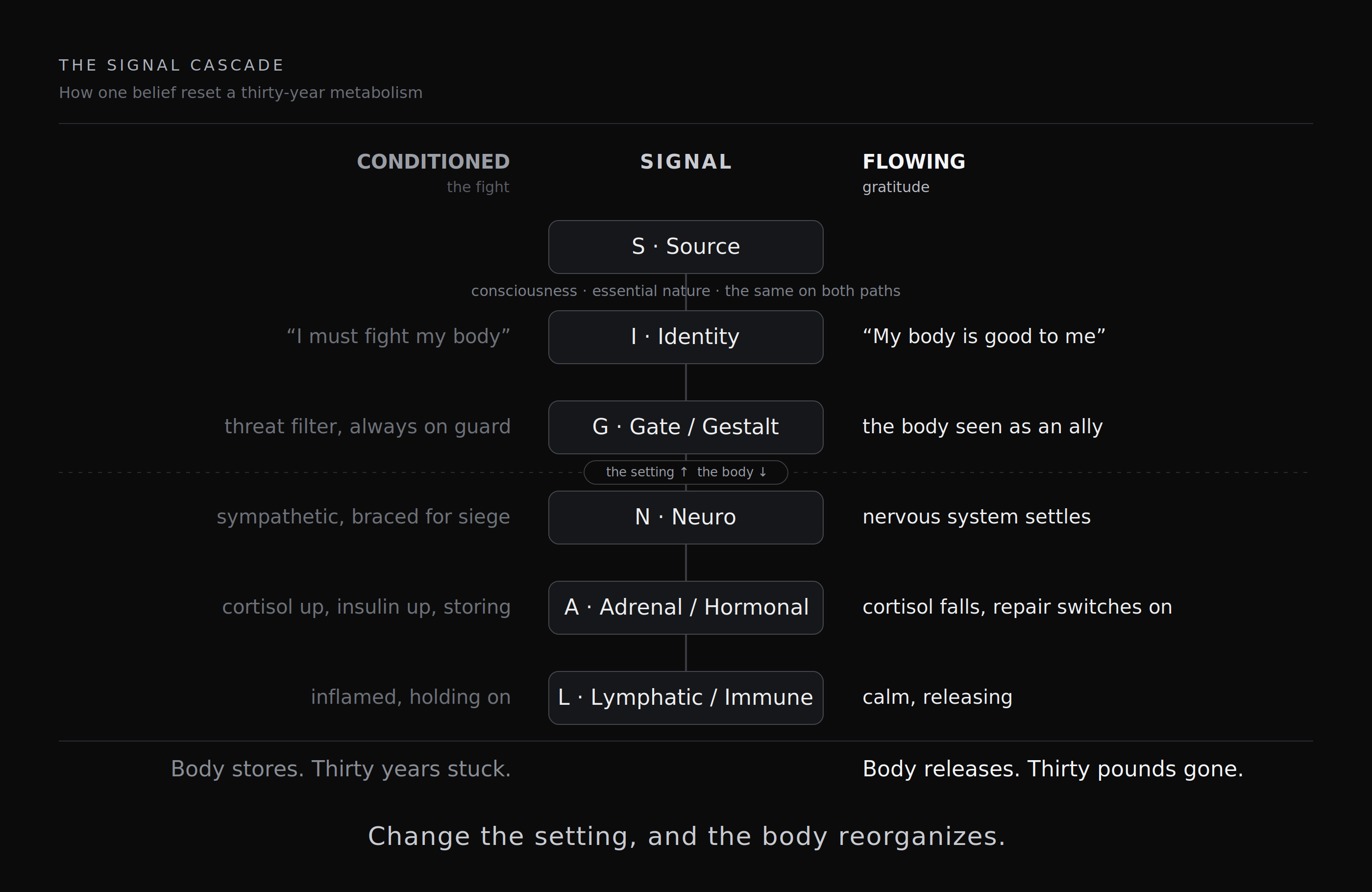
The setting is not in the food, the macros, the step count. The setting is the story a person holds about who they are and what their body is. Identity is the thermostat. Physiology is the room.
This is the claim, and I do not make it loosely. Psychology and physiology are one system, read from two ends. The story sets a number, and the body runs the building to match it.
In our work we map that one system as a cascade we call SIGNAL. Source, Identity, Gate, Neuro, Adrenal, Lymphatic. Consciousness and identity at the top. Nervous system, hormones, and immune function at the bottom. The top sets the number. The bottom holds the temperature.
None of this requires belief
The setting reaching down into the body has been measured, over and over, in ways that have nothing to do with willpower or vibe.
Start with the fastest version. Researchers gave forty-six people the same 380-calorie milkshake on two occasions. Once it was labeled a 620-calorie indulgence. Once it was labeled a 140-calorie diet shake. Same shake. When people believed they were drinking the indulgent one, ghrelin, the hormone that drives hunger, dropped steeply, the way it does after a real load of fuel. When they believed they were drinking the diet version, ghrelin stayed nearly flat, as if the body had barely eaten (Crum, Corbin, Brownell, & Salovey, 2011). The label set the number. The gut ran to match it.
That is not a quirk. It is how brains work. The leading model in neuroscience, predictive processing, says the brain is not mostly reacting to the world. It is forecasting it, and adjusting the body in advance to meet the forecast (Friston, 2010; Clark, 2013; Seth, 2021). The thermostat setting is a forecast. The body does not wait for the food. It reads the label, predicts what is coming, and starts moving hormones before the first sip. Her body had been forecasting famine and threat for thirty years, and it prepared accordingly, every single day.
Belief moves slower machinery too. Crum and Langer studied eighty-four hotel room attendants. Hard physical labor all day, well past the recommended dose of exercise, though most of the women did not count it as exercise at all. One group was told their daily work already qualified, that they were active by any medical standard. The other group was told nothing new. Nobody changed their behavior. Four weeks later the informed group had measurably dropped weight, blood pressure, body fat, and waist-to-hip ratio. The other group had not (Crum & Langer, 2007). I will be straight that this one has a mixed replication record. So hold it as real signal of uncertain size. The belief about their own bodies had moved the body itself.
The skeptic says fine, that is expectation, the mind fooling itself. So look at what happens when you remove the fooling. A Harvard team gave irritable bowel patients a placebo and told them, out loud, that it was an inert sugar pill with no medicine in it. They knew. They improved anyway, roughly fifty-nine percent reporting real relief against thirty-five percent who got nothing, a gap near what strong drugs produce (Kaptchuk et al., 2010). The belief did not have to be a lie to do work.
Go further. People who only imagined practicing a finger exercise, never touching anything, developed nearly the same changes in their brain’s motor maps as people who physically practiced (Pascual-Leone et al., 1995). Imagined action builds real tissue. This is what high performers are doing when they visualize. They are not wishing. They are rehearsing a pattern into the hardware.
Now run it the other way, the direction it ran in her. The Kaiser ACE study followed the largest version of this question across many thousands of people. The more adverse experiences someone had in childhood, the higher their risk in adulthood of heart disease, cancer, autoimmune conditions, diabetes, and early death, in a clean dose-response, and the relationship held even after controlling for adult behavior (Felitti et al., 1998). The setting gets installed young, before you can vote on it, and the body spends decades running the building to match.
It reaches all the way to the cell. Chronic psychological stress shortens telomeres, the protective caps on your chromosomes that determine how many more times a cell can divide. In one landmark study the most stressed women had telomeres that looked about a decade older than their age (Epel et al., 2004). And meaning runs it in reverse. When researchers read gene expression inside immune cells, people with a strong sense of meaning and purpose showed lower activity in the inflammatory genes and higher activity in the antiviral ones, a measurably healthier profile than people whose wellbeing came mostly from pleasure, even when both groups reported feeling equally good (Fredrickson et al., 2013). The original report drew a statistics critique, and later studies have largely held the meaning half of the finding up. Meaning reads out in the genes themselves.
There is growing agreement in obesity research that psychological and behavioral processes are not optional add‑ons but central levers in treatment and long‑term maintenance, reinforcing the idea that working at the level of identity and meaning is part of metabolic care, not separate from it (Halliday et al., 2023).
Put it together. A hunger hormone bends to a label. Body fat bends to a belief. Childhood story predicts adult disease. Stress ages the cell, and meaning calms it. The common thread is never the food or the labor or the pill. It is what the body predicted was coming. The setting.
Why telling yourself a new story usually fails
If belief can do all that, why don’t affirmations work? Why is most “manifest it” advice useless?
Because you cannot set a new number over a live opposing one.
When people with low self-esteem were told to repeat “I am a lovable person,” they felt worse, not better (Wood, Perunovic, & Lee, 2009). The new statement did not overwrite the old one. It woke it up. Saying I love my body on top of a body the system still reads as the enemy does not change the setting. It makes the old setting louder.
This is the part most of the belief-and-biology conversation gets wrong, and it is the part that actually matters. You cannot install a new story over an intact old one. The old one has to be brought up, destabilized, and re-encoded first. That is what memory reconsolidation is, and that is what DEEP did for her. It did not debate “my body is the enemy.” It reached the place that sentence was stored, opened it, and let a truer one take its place while the window was open. Clear, then set. In that order, or not at all.
She did not affirm her way thin. She changed what her body was set to, at the level where the setting actually lives.
The most powerful setting a human runs
Notice what the new setting was. It was not a neutral fact like “my body works fine.” It was gratitude. My body has taken care of me. There is meaning in that, and meaning is the most powerful setting a human runs.
We have an old line for it. “He who has a why can bear almost any how.” The thermostat version is that a strong enough why resets the whole building. The genes that calm down when a life has meaning are the same genes that inflame under a life of threat. The setting at the very top of the cascade, the one every other layer organizes around, is the meaning a person is living inside. We call the deepest version of that a person’s essential nature and their chosen purpose. It is the health work’s first cause.
This is also the honest core of what people reach for when they say manifestation. Clearing the old setting frees the parts of the brain that notice opportunity, so you start seeing, and acting on, what fear was filtering out. That is the real mechanism under the word. The universe-delivers part, I cannot speak to, and I am not going to pretend I can.
What you actually do with this
Not affirmations. Not forcing. The first move is to find the sentence your body is actually set to. Not the one you would like to hold. The real one, usually unflattering and old. My metabolism is broken. My body betrays me. I have to fight to stay acceptable. Most of these were written young, by someone who did not yet have the information to write them well.
The second move is the one almost everyone skips. You have to take the charge out of the old setting before a new one will hold. That is felt work, done at the level of emotion and body, not reasoned through from the neck up. This is where real subconscious-change tools earn their place, and where most mindset advice fails, because it tries to paint over the old number instead of clearing it.
Then, and only then, the behavioral layer starts to work the way it always promised to. The food, the training, the sleep. The same protocols that did nothing while you were fighting your own setting begin to land, because the building is no longer organized against them.
Closing
If you were to ask me, “Jade, are you really saying belief alone burns fat?” my answer is no. Identity does not magically melt fat; it changes the way your brain predicts, perceives, and behaves in your body, and those shifts in stress, choice, and consistency are what quietly move the metabolism over time. She did not lose thirty pounds by trying harder in the kitchen.
She found the thermostat. It was never in the food. It had been sitting in a sentence she had been repeating for longer than she could remember, a sentence she did not know was a setting, quietly running the whole building.
Most of us are in the kitchen, opening windows. Adjusting the room and wondering why it keeps pulling back..... The setting is upstream, in a story we did not choose and have mostly never read.
I am still working out exactly how and why this works. I will tell you that plainly, because I would rather be honest than impressive. But I have stopped doubting that the controls are real, and that they were never where I spent my career looking.
PS step into The Human Game, my Next Level Human coaching program. Spots are limited... don’t wait.
👉 http://www.nextlevelhuman.com/the-human-game
PPS If you’re a coach, clinician, or health professional who wants to learn to do this work yourself, the Human Architect and Quantum Metabolism certifications train you in the methods behind this piece, the identity and metabolic work that moves the setting instead of fighting the room.
👉 http://www.nextlevelhuman.com/human-coach
👉 https://www.nextlevelhuman.com/quantum-metabolism-certification
References
Clark, A. (2013). Whatever next? Predictive brains, situated agents, and the future of cognitive science. Behavioral and Brain Sciences, 36(3), 181–204.
Crum, A. J., Corbin, W. R., Brownell, K. D., & Salovey, P. (2011). Mind over milkshakes: Mindsets, not just nutrients, determine ghrelin response. Health Psychology, 30(4), 424–429.
Crum, A. J., & Langer, E. J. (2007). Mind-set matters: Exercise and the placebo effect. Psychological Science, 18(2), 165–171.
Epel, E. S., Blackburn, E. H., Lin, J., Dhabhar, F. S., Adler, N. E., Morrow, J. D., & Cawthon, R. M. (2004). Accelerated telomere shortening in response to life stress. Proceedings of the National Academy of Sciences, 101(49), 17312–17315.
Felitti, V. J., Anda, R. F., Nordenberg, D., Williamson, D. F., Spitz, A. M., Edwards, V., Koss, M. P., & Marks, J. S. (1998). Relationship of childhood abuse and household dysfunction to many of the leading causes of death in adults: The Adverse Childhood Experiences (ACE) Study. American Journal of Preventive Medicine, 14(4), 245–258.
Fredrickson, B. L., Grewen, K. M., Coffey, K. A., Algoe, S. B., Firestine, A. M., Arevalo, J. M. G., Ma, J., & Cole, S. W. (2013). A functional genomic perspective on human well-being. Proceedings of the National Academy of Sciences, 110(33), 13684–13689.
Friston, K. (2010). The free-energy principle: A unified brain theory? Nature Reviews Neuroscience, 11(2), 127–138.
Kaptchuk, T. J., Friedlander, E., Kelley, J. M., Sanchez, M. N., Kokkotou, E., Singer, J. P., Kowalczykowski, M., Miller, F. G., Kirsch, I., & Lembo, A. J. (2010). Placebos without deception: A randomized controlled trial in irritable bowel syndrome. PLoS ONE, 5(12), e15591.
Pascual-Leone, A., Nguyet, D., Cohen, L. G., Brasil-Neto, J. P., Cammarota, A., & Hallett, M. (1995). Modulation of muscle responses evoked by transcranial magnetic stimulation during the acquisition of new fine motor skills. Journal of Neurophysiology, 74(3), 1037–1045.
Seth, A. (2021). Being you: A new science of consciousness. Dutton.
Wood, J. V., Perunovic, W. Q. E., & Lee, J. W. (2009). Positive self-statements: Power for some, peril for others. Psychological Science, 20(7), 860–866.
Halliday, J. A., Nitschke, J. P., Best, T., Lau, W., Kothe, E. J., & Fuller-Tyszkiewicz, M. (2023). The psychology of behavior change: A neglected but necessary element in obesity treatment and prevention. Healthcare, 11(4), 597. https://doi.org/10.3390/healthcare11040597
This resonates so deeply with my own journey. For years, I felt like I was constantly battling my body, trying to force it into submission with old mindsets and corporate-style stress. Then, I made a massive identity shift and stepped into my work as a CNA last year.
I didn't start a new diet, I didn't count a single macro, and I wasn't even "trying" to lose weight. Yet, by simply stepping into this new version of myself—moving, serving, and living in alignment with my purpose—the physical weight just began to melt away. I lost about 45 pounds simply because my daily life and my identity finally shifted upstream. When we stop treating our bodies like a battlefield and start living the story we are meant to live, the metabolism truly does follow. Thank you for putting the science and soul behind what so many of us experience when we finally change the internal setting!
“The identity shifted, and the body followed.” LOVED this article!