

Your Metabolism Is Not Chemistry. It's Consciousness.
The Snake Was a Garden Hose. So Is Most of Your Suffering.

***Note: This piece draws from my original ideas, research, hooks, and metaphors. For editing and some wording, I’ve used AI tools trained on my own books and style, always blending technology with my hands-on curation and oversight. Thank you for being here—Jade.
A friend of mine was afraid of snakes. Not the polite kind of afraid. The kind that lives in the body, not the head.
She stepped into the backyard of a mutual friend, walked across the grass, and put her foot down on a black garden hose coiled in the sun. She did not think “hose.” She did not think at all. She jumped, lost her footing, and went down hard before any part of her conscious mind got a vote.
Here is the thing. Her brain did not see a hose and calculate danger. Her brain predicted a snake and ran a danger prediction before her eyes ever finished looking. The fall was real. The spike of cortisol and surge of adrenaline were real. The snake was not.
Now hold that picture, because it is the whole article in on. A brain anticipating a snake in a coiled hose is doing the exact same thing as a brain anticipating rejection in a quiet partner, ruin in a slow sales month, or judgment in a room full of people. The body answers the prediction. It does not wait for the fact.
For a century we assumed the brain was the boss. The control tower. The author of consciousness. The thing that runs you. Several independent lines of evidence are now converging on a stranger and far more useful idea: the brain is less a controller and more a predictor and a responder. And what it is predicting and responding to is not the world. It is the story you wrote about the world.
That convergence is what I have started calling quantum metabolism. Let me walk you through it the way I would walk a practitioner through it.
The brain was never the boss
The old model says the brain generates your experience and then commands your body. Newer neuroscience keeps finding the opposite. The brain spends most of its energy making predictions and then checking them against incoming signals, correcting only when reality disagrees. It is less a camera and more a betting engine.
So the real question stops being “what is the brain doing?” and becomes “what is the brain predicting against?”
The answer is a filter. A psychological filter built out of stories. The brain is not reading reality clean. It is reading reality through the story you already hold about who you are and what is safe. Most of what you call perception is prediction wearing perception’s clothes.
Which means if you want to change the body’s output, you do not start at the body. You start at the story the body is taking orders from.
How a story becomes a structure
A story alone is weak. You can question a story. You can argue with it.
What makes a story run your physiology is emotion. So let me give you the mechanism in the plainest image I have.
The story is wet cement. We have a name for that particular kind of story: a MUD, a Misguided Unconscious Decision. And that word, decision, matters. A MUD is not what happened to you. It is what you decided about what happened to you, usually before you were old enough to decide anything well.
But cement does not harden on its own. The emotion is the steel rebar. Pour the cement of a story around the rebar of a strong feeling, let it set, and you no longer have a thought. You have a structure.
That is the difference between a belief you can talk yourself out of and one you cannot. A MUD with no emotional charge is a thought you can question. A MUD with emotional charge is a felt reality you cannot argue with. Story plus emotion equals belief. Cement plus rebar equals something that holds weight for forty years.
You are not an identity. You are identities.
Beliefs do not stay single. They stack. And when enough of them set in the same direction, you get an identity.
Notice I said an identity, not the identity. Because you are not one. I have a goofy side and a professorial side. I have an athlete in me and an Italian who would like to eat the entire breadbasket. Those are different identities, each one a small stack of stories and the feelings that hardened them.
When those identities integrate well, you get a personality. Your personality is the sum total of every story, every charge, every belief, every identity structure you carry. And here is where it stops being psychology and starts being biology.
That personality functions like a pair of sunglasses you forgot you put on. It is a gate. It decides, before you are conscious of deciding, how you will see yourself and how you will see the world. And a particular way of seeing sets a particular nervous system holding pattern.
If you wrote a story that you have to perform in order to belong, your nervous system is not neutral. It is scanning. Tuned for criticism, primed to catch the one disapproving face in a happy room. If you wrote a story that the world is not safe, your system is not waiting for evidence. It is already hypervigilant, already running the cortisol, already braced.
In a very real sense the nervous system is predicting and responding to a world that may not exist. It is responding to the story you wrote about the world you think you are in. Same machinery as my friend and the hose. Just slower, quieter, and running for decades instead of a second.
The cascade: from story to cell
This is where it leaves the head and enters the tissue, and it follows an order. In our work we call that order the SIGNAL cascade, and you can read it top to bottom.
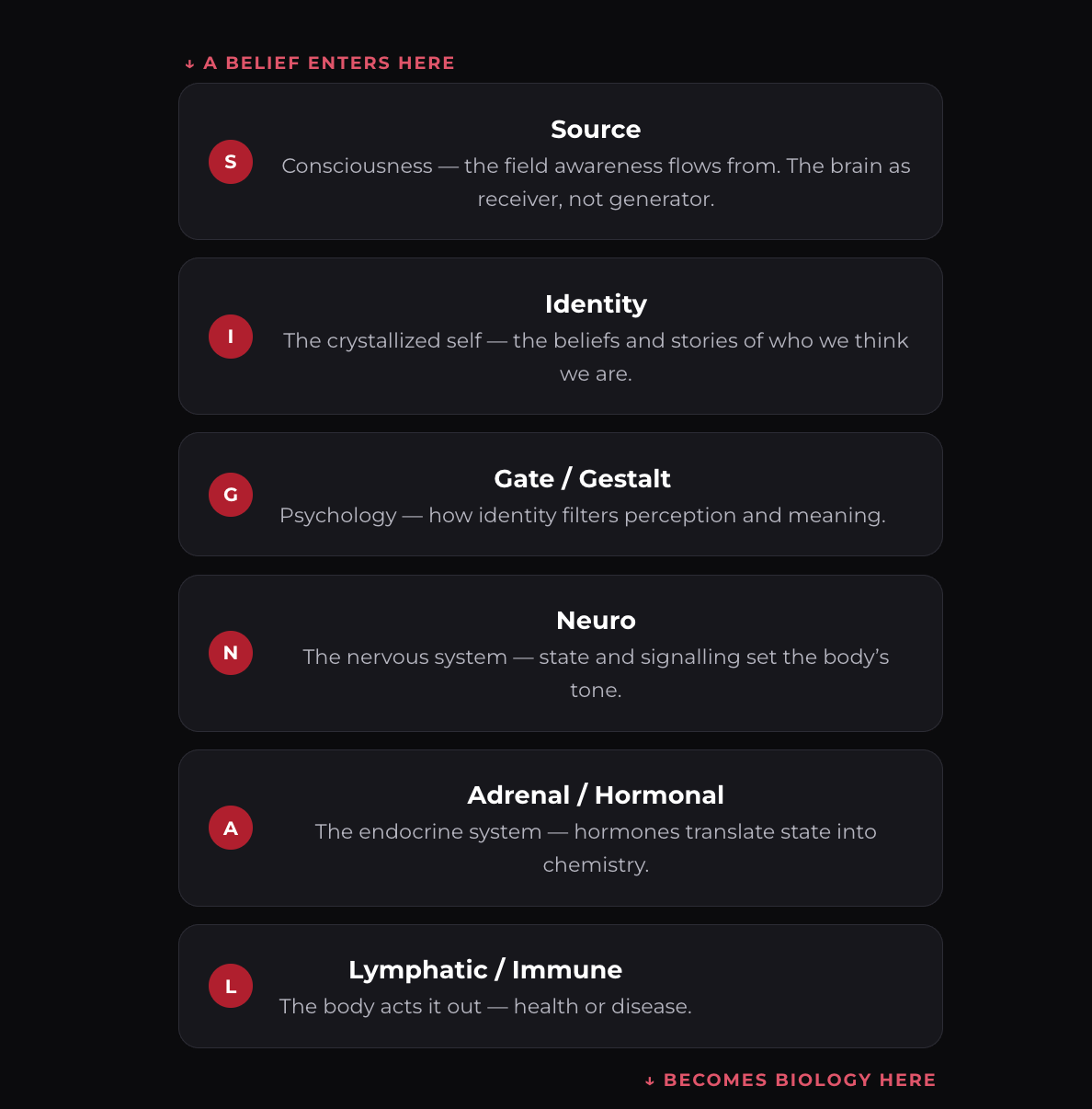
It begins in consciousness, hardens into identity, expresses as the gate of your perception, sets the state of the nervous system, drives the hormonal and adrenal output that state demands, and finally lands in the immune system and the tissue itself. Source to cell. Every single time.
None of that last stretch is fringe. The chronic activation of a threatened nervous system, the downstream hormonal cost, the way that cost bleeds into immune function, this is the well-mapped territory of psychoneuroimmunology. Mainstream science has understood for decades that a stressed mind writes itself into an immune system.
What it has been slower to admit is the top of the chain. That the “stressor” is often not an event at all. It is a prediction. A coiled hose your story insists is a snake.
The part the science can’t find
Now the harder half. The quantum half. The part that is not physical.
Go looking in the brain for an emotion and you will not find one. Go looking for a belief, a story, an identity, and you will not find those either. You will find correlates. You will find regions that light up when a feeling is present. You will never find the feeling.
Materialist science tends to wave this away, to act as if your fear and your faith and your sense of self are obviously stored somewhere in the wet tissue, filed like documents. That has never been demonstrated. This is the hard problem of consciousness, and it is not a small footnote. It is an open wound in the middle of the whole field.
So here is the claim, and I am going to label it honestly as mine. The brain is not the source of these things. It is the responder to them. Consciousness, story, belief, and identity are not made of matter, and yet they reliably become matter. They become tissue, metabolism, nervous system tone, biochemistry. Understanding how the non-physical becomes physical is the actual frontier. That bridge is what quantum metabolism is trying to name. It is my model and my extension of the science, not a settled finding, and the credibility of the claim depends on me not overselling it.
A possible bridge (and why I flag it as mine)
If thought becomes tissue, there has to be a route. Here is the most interesting candidate I know of, and here is me telling you plainly that it is a hypothesis.
The route may run through the body’s water and its fascia. Through coherence domains in biological water, through the fascial network that wraps every structure you have, and possibly through biophotons, faint light, moving along those lines. A way for an energetic, non-physical pattern to write itself into a physical one.
I flag that hard because it is not proven. But it sits inside a field that is no longer fringe at all. Quantum biology is having a genuine renaissance. We now know photosynthesis uses quantum effects. We know some birds navigate by them. We know enzymes in your own body use quantum tunneling, and that your mitochondria appear to be playing quantum games too. The strange physics is not staying politely inside the physics department. It is showing up in living things. In you.
And yet notice what almost everyone in that space talks about. Light. Grounding. Water. Biophotons. Mitochondria. All real, all worth studying. Almost no one is looking at the belief structures sitting on top of all of it. That is the gap. That is the work.
Some science, graded honestly
I will not hand you a pile of studies and pretend they all carry equal weight. Here is the honest grading.
Established. That belief changes biology is not in dispute. The placebo effect is the most reproduced finding in medicine. Alia Crum’s milkshake study showed the body’s hunger hormones responded to what people believed they were drinking, not to the calories. Ellen Langer’s counterclockwise study put older men in a setting staged to 1959 and measured their bodies growing physiologically younger. Crum and Langer’s hotel housekeepers lost weight after simply being told their daily work counted as exercise, nothing else changed. The stories we tell ourselves move the tissue. This is settled.
Emerging. Energy work appears to do something, even where the mechanism is unsettled. Reiki shows up in the literature with effects we cannot yet cleanly explain. In the 1980s, Pierre de Vernejoul injected a radioactive tracer, technetium-99m, into acupuncture points and watched it migrate along the very meridian lines traditional Chinese medicine mapped centuries ago, possibly the fascial network at work. And the chakra question is no longer empty: the ancients described them in precise detail, each one sits at a major nerve plexus, each one maps onto an endocrine gland, and in 2020 Jens Rowold and Paul Hewson measured “biofield frequency bands” and found the strongest high-frequency signal at those exact locations in experienced biofield practitioners.
Speculative, and mine. The water-fascia-biophoton bridge. The full quantum-metabolism synthesis. The claim that chakras are “real” in a literal energetic sense. These are the frontier. I hold them as live hypotheses, not facts, and I will tell you that every time.
What I have watched in the room. I will not dress clinical observation up as proof, so take these as exactly what they are. On a podcast I documented my colleague Naomi Hahn moving through a process we use called DEEP and watching a chronic, supposedly incurable hepatitis B effectively disappear. I have watched decades of back pain resolve after this work. I have watched people lose forty pounds without dieting once the belief structure underneath the weight changed. N of one, every time. But enough ones start to mean something.
The mechanism underneath all of it
If all of this is true, the obvious question is: how would you ever change a structure that hardened thirty years ago?
Not by arguing with it. You cannot talk someone out of rebar.
The mechanism is memory reconsolidation, and it is real neuroscience, not metaphor. Karim Nader’s lab first showed that a reactivated memory becomes briefly unstable, and Bruce Ecker’s clinical work turned that finding into a repeatable method. When you bring a belief up and light it with its original emotional charge, the memory does not stay fixed. For a window of time it becomes labile, editable. And if, in that window, the system meets a genuine prediction error, an experience that contradicts the old story at the felt level, the structure can be rewritten. Not coped with. Rewritten.
That is the engine. In our language it runs in three movements: Rewrite the story, Rewire the charge, Retrain the body. Everything energetic we do has a neural correlate underneath it. The non-physical and the physical, working the same lever from two ends.
So what is this work, really?
Step back and look at what we have described. A practitioner who can see that a client’s metabolism, mood, and immune system are downstream of a story. Who can find the MUD, feel for the rebar, and stay with a person inside the reconsolidation window long enough for the structure to actually move. Who is fluent in the hormones and the immune cascade and in the consciousness sitting on top of them. Who works the whole chain, Source to cell, instead of handing out one more meal plan to a nervous system that was never going to comply.
That is not a nutritionist. It is not a mindset coach. It is not a therapist. It is something the field has not had a clean name for, and it is exactly the practitioner the next decade is going to need.
We are standing on the threshold of a genuinely different way of working with human beings. At Next Level Human, I built a certification to teach it. But you do not need the title to start. You need to start seeing the chain.
The body is not a machine taking inputs. It is listening. The only question is what story it has been listening to.
PS: If you want to go deeper into quantum metabolism, the mechanism, the cascade, and how to actually work at this level, I put together a place to start. It is free, and whether or not you ever train with us, you will leave understanding your own biology differently. That is yours to keep either way.
→ https://app.nextlevelhuman.com/widget/form/KmW8c4nkbKU3xoycaLJ9
References
Barrett, L. F. (2017). How Emotions Are Made: The Secret Life of the Brain. Houghton Mifflin Harcourt.
Cifra, M., & Pospíšil, P. (2014). Ultra-weak photon emission from biological samples: Definition, mechanisms, properties, detection and applications. Journal of Photochemistry and Photobiology B: Biology, 139, 2–10.
Crum, A. J., Corbin, W. R., Brownell, K. D., & Salovey, P. (2011). Mind over milkshakes: Mindsets, not just nutrients, determine ghrelin response. Health Psychology, 30(4), 424–429.
Crum, A. J., & Langer, E. J. (2007). Mind-set matters: Exercise and the placebo effect. Psychological Science, 18(2), 165–171.
de Vernejoul, P., Albarède, P., & Darras, J. C. (1985). Étude des méridiens d’acupuncture par les traceurs radioactifs [Study of acupuncture meridians using radioactive tracers]. Bulletin de l’Académie Nationale de Médecine, 169(7), 1071–1075.
Ecker, B., Ticic, R., & Hulley, L. (2012). Unlocking the Emotional Brain: Eliminating Symptoms at Their Roots Using Memory Reconsolidation. Routledge.
Langer, E. J. (2009). Counterclockwise: Mindful Health and the Power of Possibility. Ballantine Books.
Lambert, N., Chen, Y.-N., Cheng, Y.-C., Li, C.-M., Chen, G.-Y., & Nori, F. (2013). Functional quantum biology in photosynthesis and magnetoreception. Procedia Chemistry, 9, 1–16.
Langevin, H. M. (2021). Fascia mobility, proprioception, and myofascial pain. Life, 11(7), 668.
Nader, K., Schafe, G. E., & LeDoux, J. E. (2000). Fear memories require protein synthesis in the amygdala for reconsolidation after retrieval. Nature, 406(6797), 722–726.
Pennebaker, J. W. (1997). Writing about emotional experiences as a therapeutic process. Psychological Science, 8(3), 162–166.
Pollack, G. H. (2013). The Fourth Phase of Water: Beyond Solid, Liquid, and Vapor. Ebner & Sons.
Rowold, J., & Hewson, P. D. (2020). Biofield frequency bands—Definitions and group differences. Global Advances in Health and Medicine, 9, 1–11. https://doi.org/10.1177/2164956120982568
"The body is not a machine taking inputs. It is listening. The only question is what story it has been listening to."
This is the architecture. The story is the pattern. The emotion is the rebar. The body is the recorder. The healing is not in changing the story. It is in recognizing the pattern and letting the field reorganize around the recognition.
Thank you for this rigorous and grounded reframe.
You are definitively on the right track which I can say based on my direct experience of most “experts” and mainstream practices and science being on the wrong track.
I had bipolar disorder II. The kind that makes you run naked in Manhattan naked, have psychosis, get forced into an ambulance, and need to be held down by officers to get tranquilized with antipsychotics. I’ve met a peer counselor who tried to get off her meds and ended up hospitalized 11 times before giving up. There is no known cure for bipolar disorder II. Cancer is more well understood than bipolar disorder. The only accepted treatment is lifelong anti-psychotics and regular visits to the doctor.
There was not a single person or doctor I knew who knew that a cure was possible. I read that a random anonymous person on Reddit said it got cured for him and he mentioned no idea how. And also Kapil Gupta telling me I am not my thoughts. The fact that it was possible was enough for me try even though I had no idea how. I was willing to die trying. The result?
Last time I had a manic episode and me taking any meds or seeing a psychiatrist was 3 years ago. An awakening experience triggered a slight (controlled) manic episode (perhaps they are one and the same) where I deconstructed every belief most of which were beliefs I had about myself. Total self annihilation. For weeks it felt like my brain was being rewired. No manic episodes and no antipsychotics needed since. Completely free. No surgery. No maintenance. No doctors. No therapists.
Similar approach taken for my addictions and anxiety with similar outcomes so it’s not specific to bipolar. You are absolutely right.