

When EMDR Doesn’t Go Deep Enough
Why your symptoms may improve but your patterns stay the same.

**Note: This piece draws from my original ideas, research, hooks, and metaphors. For editing and some wording, I’ve used AI tools trained on my own books and style, always blending technology with my hands-on curation and oversight. Thank you for being here—Jade.
You can spend years doing “the work,” feel your symptoms drop, and still find yourself dating the same person in a different body, having the same fight in a new job, living out the same story with a calmer nervous system. The relief is real and it also changes nothing.
EMDR, short for Eye Movement Desensitization and Reprocessing, is a wildly popular therapy where you hold a painful memory in mind while moving your eyes back and forth, and it can make the memory go quiet and stop running your life, which is exactly why it is worth asking whether quiet is the same as healed.
EMDR can make you feel dramatically better and change almost nothing fundamental about you. Both of those are true at the same time. The data says so, and if you have done EMDR, or run it on other people, your own experience probably says so too.
Let me be clear before anyone braces for an attack. EMDR is one of the most effective trauma treatments we have. It is recommended for PTSD by the World Health Organization, the Department of Veterans Affairs, and the major trauma-treatment bodies, and there are dozens of controlled trials behind it (Landin-Romero, Moreno-Alcazar, Pagani, & Amann, 2018). If you are using it, you are already doing better work than most of the field. This is not an argument against EMDR. It is a look under the hood at which depth it usually works at, and how to deliberately push it deeper.
If you are a practitioner… and your honest… you have watched it happen. The flashbacks fade. The memory loses its grip. A client cries, exhales, says it feels far away now. And six months later the same relational pattern is running, the same choices, the same person walking into the same wall with a calmer nervous system. The symptom lessened… for a time. The self did not move.
And one thing before we go under the hood, because it reframes everything that follows. The tools in this article were mostly built to treat trauma, and most of the people using them are trying to relieve suffering and get someone back to okay. That is good and necessary work. It is not the work I am most interested in. I am not in the business of getting people back to zero. I am in the business of transformation, of a person becoming someone they have never been. And here is what gets lost. The exact mechanism that relieves a trauma is the mechanism that transforms a life. Most of the field is using a transformation-grade engine to do repair-grade work. This piece is about that gap, and about how to use the engine for everything it can actually do.
To understand why, you have to go back to the oldest version of this problem… how we evolved.
A body at the water
Picture it. You and another person, let’s call him Mike, walk down to the waterhole at dawn, the way you have a hundred times. Mike kneels at the edge to drink. The water moves strangely. Then suddenly something explodes out of it, and Mike is gone, and you are running before you have decided to run.
That night you cannot sleep. Your body will not put the picture down. For days, every time the wind carries the smell of still water and mud, your heart slams and your legs want to move.
Here is what your brain just did, and it is one of the most useful things a brain has ever learned to do.
In a single experience, with no practice and no repetition, it wrote a rule and burned it in deep. This water can kill you. It did not file that away as a calm fact, the way you remember a phone number. It welded the rule to raw fear, stored it underneath thinking, and set it to fire faster than thought.
Slow down on why that is brilliant, because it’s critical to get clear on the mechanism.
A brain that needed ten crocodile attacks to get the message would belong to a dead animal. There is no second lesson if the first one eats you. So evolution did not build us to learn about deadly things slowly and carefully and on purpose. It built us to learn them in one try, instantly, emotionally, permanently. It even built us to over-react. Flinching at a stick that turns out to be a stick costs you a second. Not flinching at a snake that turns out to be a snake costs you everything. So the brain writes the dangerous rule hard and sorts out the details later.
Now here is the part that matters most, and the part I want to define more clearly than it usually is.
You did decide something at that waterhole. Not with your thinking, planning, adult mind. Underneath that, in the fast part of you that makes survival calls in a quarter of a second, you made a decision about how the world works. Water means death. And probably more than that. Standing there while the water took Mike, some part of you may have decided I could not protect him, or it is not safe to let your guard down, or the people I love get taken when I am not watching. You did not say those words. You decided them anyway, the way a small child decides the dark is dangerous without ever forming a sentence about it.
That is what I call MUD. A Misguided Unconscious Decision. Unconscious, because you did not choose it on purpose or think it through. A decision, because you did choose it, fast, underneath, with whatever wisdom you had in that one terrible moment. And misguided, in the end, because a snap rule that saved your life at dawn is almost always too crude to run the next forty years on.
Notice the second thing your brain did. It did not just store one fact about one crocodile. It made meaning. Water means death is a rule, and a rule travels. It protects you at the next pond, the next river, a lake you have never seen. That is the second gift evolution stacked on the first. A creature that can turn one event into a general rule does not have to get bitten everywhere to learn everything. Meaning is how a single morning becomes a lifetime of caution.
So far this is survival machinery working perfectly. Fast fear. A snap decision. A rule that travels. You are alive.
The trouble is that the rule is too blunt to keep. You still need water to live. A whole life organized around the idea that “water means death” is just a slower way to die. Which is exactly why evolution did not stop there.
The wound was built to heal
Evolution gave us a second machine, and it runs on a longer clock. The first machine writes the rule fast. The second one is built to go back, feel all the way through the wound, and turn the blunt rule into something wiser and more refined. I have a pithy rhyme for how that is supposed to go: Feel, Deal, Heal.
Watch it in something small first. You cut your finger chopping vegetables. Nobody has to teach you what happens next. You stop, you drop the knife, you grab the finger, you feel it. That is the FEEL phase. The pain is not your enemy here. It is your body forcing your attention onto the wound so the wound gets tended. Then you look at it. How deep, how much blood, bandage or stitches. You clean it and close it. That is the DEAL part. And over the next days the skin knits, the cut closes, and something quietly updates in you, so that next time you are near a knife your hand sits differently. The wound left wisdom behind. That is the HEAL.
A crocodile and a kitchen knife are the same shape of event at different sizes. The ancient version of feel, deal, heal for losing Mike looked like this. You felt it, the terror and the grief, all the way through, probably for a long time, probably with the whole tribe around a fire. You dealt with it. You talked it through, and the older ones who had lost people before helped you carry it. And slowly you healed, which never meant you forgot. It meant the raw rule grew up. Water means death matured into something you could actually live on. This water holds danger and life both. Here is how to read it. Here is the safe hour. Here is how to approach. Here is what we now teach the children so it does not take another one of us. The tragedy becomes a teaching. The fear became a skill the whole tribe could use.
That arc is evolution. The tribe that could turn a death into wisdom and hand it down out-lived the tribe frozen in a blanket of fear around water. Feeling, then dealing, then healing is how a dangerous experience becomes an advantage instead of a cage. And when the loop finishes, the MUD updates. The snap decision made by a terrified younger you gets revised by an older, wiser you who has felt it through and made better meaning of it. That is the design.
Where it breaks in modern life
Here is what goes wrong now, and it is the reason a safe, well-fed, modern person can carry a wound for thirty years that someone at that fire would have metabolized in a season.
Modern life allows us to stop in the middle.
We are fairly good at the first step. We feel the fear, the loss, the shame. We are also very good at a counterfeit of the second step. Instead of truly dealing with the wound, we cope. We distract, we numb, we stay busy, we drink, we scroll, we organize a whole life around never going near the smell of that water again. It feels like handling it. It is mostly just turning the volume down and walking away. And because we never go back, feel it through, and make new meaning, we never reach the third step. We never heal. The arc freezes halfway.
A wound that is only partially felt, never dealt with and never healed does not dissolve. It hardens. The snap decision made by the terrified younger you, the MUD, sets like cement and runs the rest of your life from underneath. You are not avoiding one waterhole anymore. You are a person who cannot relax, cannot trust, cannot let anything you love stand near the edge of anything, and you do not even remember deciding it.
And here is what makes this everyone’s problem… most of the decisions running your life were never made in a moment that traumatic. They were made quietly, in a thousand small scenes nobody would ever call trauma. A look on a parent’s face. A classroom where you felt stupid. A love that only showed up when you performed. Those quiet moments wrote decisions too. I am too much. I am not enough. I have to earn my place. And because they were quiet, they were never felt, never dealt with, never healed. They hardened in the dark and became the personality you think of as you. You do not need a trauma to need transformation. You only need to have been a child once.
That is the difference between coping and healing, and almost everything sold as healing is actually very good coping. Coping makes the pain quieter. Healing changes what the pain means, and who you become because of it. One you have to keep doing forever. The other finishes.
So when we look at any tool, the real question is never “did it help.” Plenty of things help. The question is “did it complete the arc, or did it just build a very comfortable place to stop halfway.” To answer that, you have to know exactly what a brain can do with one of these old learnings. There are four moves, and they line up with feel, deal, and heal.
The four depths
Think of old fear as a recording that plays whenever the trigger shows up. There are four things a brain can do with it. The first two are kinds of dealing. The last two are kinds of healing. All are useful, but only the last two complete the loop.
Regulation. Depth one is regulation. You turn the volume down. You stand near the water and use breath, or a calming thought, or bilateral stimulation, to keep the fear from running the show in the moment. Mechanically this is the front of the brain pressing down on the alarm center, the prefrontal cortex quieting the amygdala. No new learning happens here. The recording is untouched. You just turned the knob, and the moment you stop, the volume climbs back. This is the calming half of coping. Again, this is not bad. In fact it’s useful. It just wont heal you.
Extinction. Depth two is extinction. This is a research term. I dont love it because to me it sounds like something that disappears. That is not what it is. Extinction is about building a second, competing learning and laying it on top of the first. You visit the water at midday for two weeks, when the crocodiles are quiet, and nothing bad happens. A new memory forms, water at noon is safe, but it does not erase the old one. The old water means death sits underneath, fully intact, and the brain now keeps both recordings and needs to pick between them. This is standard exposure therapy. It is most cognitive reframing. It is every diet you have ever quit. And when you go at dusk, or a hard year hits, the old recording comes back exactly as it was. Avoidance is the dysfunctional version of this, where you cope so well by staying away that the old rule never gets challenged at all, and so it never weakens.
Those two depths are the DEAL. They are real, often necessary, and they are where most of the relief in the world ends. They are not the HEAL.Reconsolidation. Depth three is reconsolidation. This is the first move that “edits” the original recording at the source. In 2000, Karim Nader and colleagues showed that when a “fear-memory” is pulled back into active feeling, it does not stay solid. For a window of a few hours it goes unstable, editable, dependent on the brain making fresh protein to lock it back down (Nader, Schafe, & LeDoux, 2000). During that window, if the old emotional learning encounters an emotionally charged example or experience that directly contradicts it, the recording itself gets rewritten. This is not a louder voice on top. It is not suppression. The original, gets changed. The charge drops at the source. This is where the HEAL begins.
Integration. Depth four is integration. The rewritten learning gets woven into who you are, so the original can never grow back the same way. The water stops being only danger you can manage. It becomes part of a deeper more nuanced story. It took someone, and it feeds the village at the same time. The fear it left taught you to read the world for real threat. You become the person others send to the hard places, because you move through them with a steadiness you had to earn. This is the HEAL completed. It is you turning a death into a learning and a teaching for you and all tribe members who listen. You are now the holder of deep experiential wisdom.
Let’s label integration honestly. The cleanest neuroscience supports the first three depths as distinct processes with distinct machinery. Integration as its own deepest layer is grounded in research on narrative identity and how people grow after hardship, but as a separate, necessary fourth level it is my model and my extension of the science, not a settled finding. The credibility of the claim depends on me not overselling it. I believe true healing comes only after the emotional material has been metabolized into meaning and that generated into purpose.
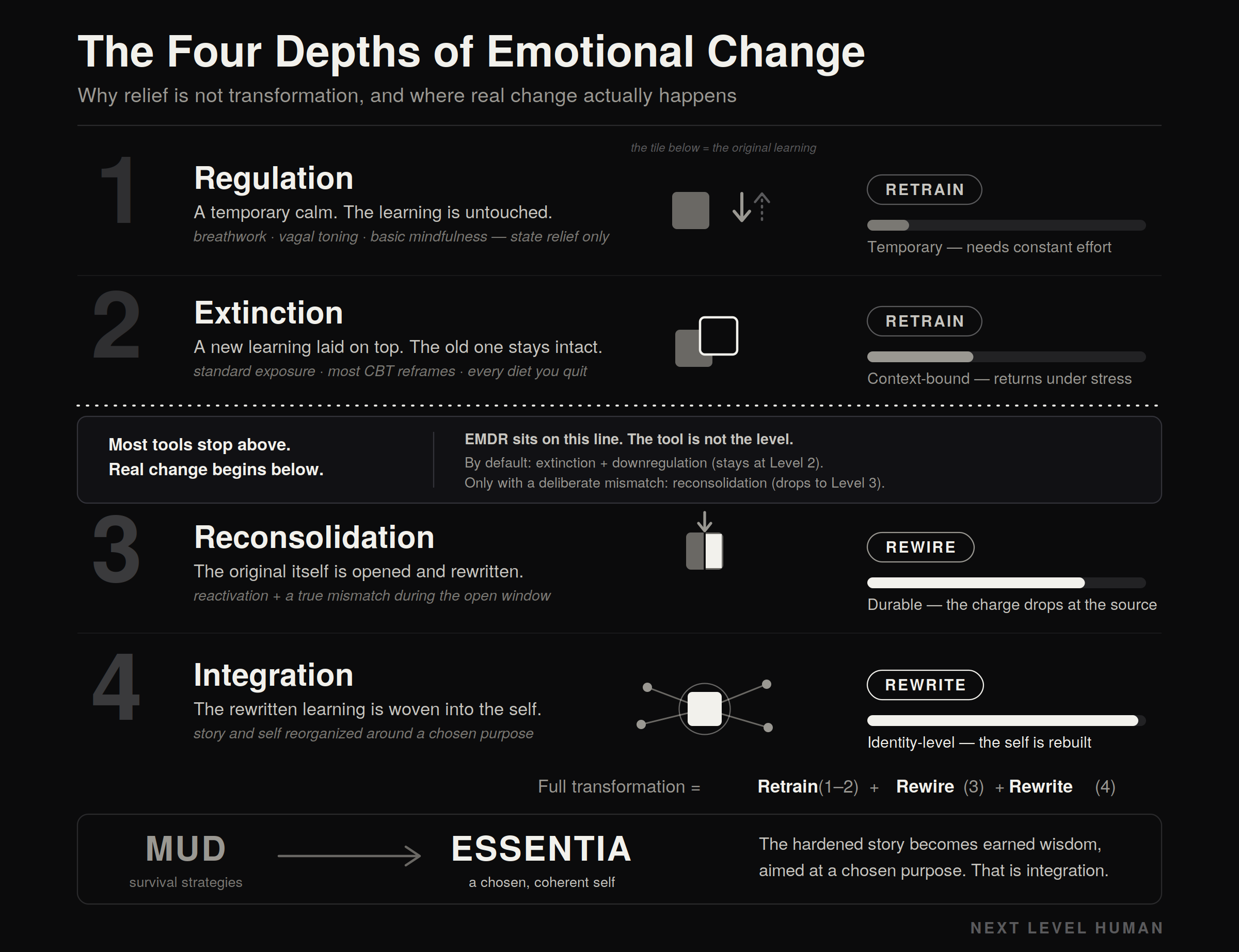
The four depths of emotional change. EMDR sits on the threshold: extinction and downregulation by default, reconsolidation only with a deliberate mismatch.
What EMDR actually does, reliably
Now let’s talk about EMDR. For those unfamiliar this is a technique that the psychology space has dubbed its new sweetheart of the moment. But does it actually do the HEAL?
The best-supported account of how EMDR works is almost disappointingly mechanical. A 2018 systematic review of eighty-seven mechanism studies found the strongest evidence for one idea, working-memory taxation (Landin-Romero et al., 2018). When you hold a distressing memory in mind and at the same time track a finger, or feel alternating taps, or hear tones side to side, that second task competes for working memory. It’s the psychological equivalent of tapping your head and rubbing your tummy. Working memory is small. Two demanding jobs will not fit. So the memory MAY come back thinner, less vivid, less charged, and it MAY get stored that way (van den Hout & Engelhard, 2012). The same review found consistent physiological calming across sessions, the body downshifting out of alarm.
Read that again, because it explains a lot. The reliably demonstrated effect of EMDR is that it turns down the vividness and the emotional charge of a memory, and it calms the body. That is real. For a lot of people it is the difference between a flashback that hijacks them and a memory that can be held and then put away.
But look at where those two effects land on the map we discussed. Turning down the charge is regulation. Storing a quieter, safer version of the memory is desensitization, a close cousin of extinction. EMDR, run the standard way, is a sophisticated tool for the DEAL phase. It is spectacular at regulation and extinction. It takes a 4K, surround-sound trauma and renders it grainy and more quiet.
But making the movie fuzzier is not the same as changing the plot.
The part nobody told you about EMDR
Here is where it gets uncomfortable, and I think genuinely useful.
The story most of us were taught is that EMDR reprocesses the memory. That the bilateral stimulation, the eye movements, somehow unlocks and rewrites the original trace. Reconsolidation in other words. The HEAL. Depth three.
The research does not support that as the default. It supports it as a possibility that depends on a condition the eye movements may have nothing to do with.
In 2013, Sevenster, Beckers, and Kindt ran a clean experiment on human fear memory. They found that simply reactivating a memory is not enough to make it editable. For the trace to actually destabilize, to enter that labile, rewritable window, the reactivation has to contain a prediction error, a mismatch between what the old learning expects and what actually happens. When they reactivated a fear memory with no surprise in it, the memory did not become labile at all. It just sat there and re-stored itself, unchanged (Sevenster, Beckers, & Kindt, 2013).
Sit with that. You can bring a memory fully online, feel it in your body, run bilateral stimulation, watch the charge come down... and never once open the file for editing. The vividness drops because working memory got taxed. The core decision underneath, I am powerless, I am not safe, it was my fault, is never touched, because nothing contradicted it. It was reactivated. It was not rewritten. That is FEEL and DEAL. It is not nothing, but it is not HEAL.
The literature is clear on this. The most thorough review of human reconsolidation to date concludes that while there is a wealth of findings consistent with it, the evidence is inconsistent enough that we cannot yet confirm reconsolidation is what is happening at the neurological level. It remains, in their words, viable but hotly contested (Elsey, Van Ast, & Kindt, 2018). Even the most famous human demonstration of reconsolidation-based fear reduction was later reanalyzed and found unreliable once you looked at how participants were excluded (Schiller et al., 2010; Chalkia, Van Oudenhove, & Beckers, 2020).
So here is the smoking gun, and it is not what most trainings teach. The thing that rewrites a memory at the source is a prediction error during reactivation. The eye movements are not that. The bilateral stimulation taxes working memory and calms arousal, which makes the memory quieter and the session more bearable. It does not, by itself, create the mismatch that opens the trace. Nothing in the standard protocol guarantees one. And as an aside eye movements are likely no different than bilateral stimulation in any other form… i.e. tapping, chest thumps, marching, alternating stroking, etc.
Which means the active ingredient in transformational EMDR was never the eyes. It was you. The clinician. The moment, planned or accidental, when the client touched the old unbearable decision and something contradicted it hard enough to register as a surprise. When that happens, you are in reconsolidation. When it does not, you are doing excellent depth-one and depth-two work and calling it depth three.
That is not a flaw in EMDR. It is a map. It tells you exactly what to add.
How to turn relief into a rewrite
If you want EMDR to reach the HEAL phase on purpose instead of by luck, you engineer the conditions the science says are required. In my language these are Rewiring (the emotional charge) and Rewriting (the subconscious story), and the work is to run them together rather than in a line.
Three conditions have to be met for reconsolidation, the Rewire. First, precise reactivation. Not “let’s think about the trauma,” but bringing the specific decision fully online, the felt sense of I am powerless, in the actual scene where it was made. Second, a real mismatch while that decision is active.
The client has to experience something that directly contradicts the old decision at the same moment they are in contact with it, a felt sense of safety, agency, adult capacity, or compassion, vivid enough to register as a genuine surprise to the old belief. That contradiction is the prediction error and it is far from guaranteed in a session. That is the thing the bilateral stimulation cannot manufacture for you.
Third, do not over-soothe. If you rush to calm the client down the instant the hard feeling appears, you can close the window before anything updates, and you drop back into pure depth-one relief.
In practice that looks like helping the client stay with the old decision long enough for it to fully activate, then deliberately bringing in and holding the contradicting experience in the same moment. Not talking them out of the belief. Letting them live something the belief did not predict. Keep that collision alive long enough for the work to be done. That, not the eye movements, is the reconsolidation window.
Then comes the part EMDR almost never does on its own, the Rewrite. Even a clean reconsolidation can leave you with a quieter memory and the same life story. The charge dropped, the person feels different about the event, and they still live inside the old identity. To finish the arc you weave the new learning into who they are.
Afterward the questions are simple: given how this feels now, what did this experience give you that you could not have had any other way? What kind of person does that make you today? Who are you able to become that never would have been possible without this? Life happened, how will you happen back?
That is the jump from MUD to Essentia (your chosen work that only you can do in the way you can do it). In our example a death turned into a teaching… run through one human being… that adds to the wisdom of the collective.
What this is, in my language
In the work I teach, the wound is a decision that hardened. I call it MUD, Misguided Unconscious Decisions, the meaning a young or overwhelmed person made in a charged moment without the maturity to make it accurately. Over years it sets from a mud puddle to clay to cement. Fused to that cement is the emotional charge, the steel rebar that keeps it rigid. You cannot argue cement out of someone. You have learned that the hard way if you have ever explained to a person, correctly and kindly, exactly why their fear was untrue, and watched it not move an inch.
Change happens at the level of the story, not the strategy laid on top of it. Healing, in clinical terms, is two moves run together. Rewire goes after the rebar, the emotional charge held in the body, and this is where a well-run reconsolidation lives. Rewrite goes after the cement, the story-decision and its meaning. A third move, Retrain, wires the new pattern into actual behavior and supplies the regulation that lets you open the window in the first place. EMDR, used well, is a strong Rewire engine with a built-in calming effect. What it does not do on its own is the Rewrite.
Run the Rewire alone and you get calm without change. The charge drops, the person feels better, and the unchanged decision quietly rebuilds the charge over the following weeks. That is the unfortunate EMDR pattern. It is the arc frozen one step from the end… FEEL—> DEAL—> HEAL never completes.
Integration is not self-care, and it is not a journaling worksheet after the session. It is the move from MUD to Essentia. You take the buried thing, the wound, and you pull the wisdom out of it, the earned understanding that could only have been forged in that specific fire, and you aim it at a chosen purpose. The old decision, water means death, I am not safe, gets metabolized into something true and usable: because I survived this, I became the person who can read danger, protect the people I love, and walk into hard places with steadiness.
EMDR can help you DEAL so you can carry the memory. But only integration can get you to HEAL. That means the fear does not get managed. It gets turned into identity.
How to tell which depth you actually reached
You do not need a lab. You need honest questions.
Does it hold when you are not using a technique? If you have to breathe, tap, or talk yourself down every time, you are at regulation. Useful…. but not complete.
Does it come back in new situations? If the calm holds in the room and at noon but breaks at dusk and in the next relationship, you ran extinction NOT reconsolodation or integration. The original is still intact underneath.
Did the charge drop at the source? If you can bring the old memory up and it simply does not light the body the way it used to, without you doing anything, something reconsolidated.
And the deepest one. Can you say, with a straight spine, “this taught me something, and because of it I am the kind of person who can do this”? Can you tell a more true, larger story where the thing that nearly broke you became the origin of something you value in yourself? That is the HEAL running to completion. That is Essentia. If the facts are the same and the charge is just lower, you have relief, and relief alone will not hold.
One more thing… do not skip the calming because it is only the surface. It is useful. You usually cannot open the deep window in a flooded system. Steady the body first. This to me is the most useful aspect of somatic bilateral stimulations like EMDR. Just do not mistake that steadying for the final destination.
Back at the water
Let’s return to the waterhole one last time.
The person who avoids it survives, smaller. The person who breathes through the fear and goes anyway functions, effortfully. The person who relearns it is safe at noon is fine until dusk. The person whose terror finally rewrites itself into manageable risk is genuinely freer.
But the one who changed is the one for whom the water became something else entirely. A place that can take life and also gives life. A teacher. The reason they now move toward danger with an earned steadiness they hand down to their kids without trying. That is not a quieter memory. That is a different human being entirely. The fear got felt, and dealt with, and finally healed, all the way to the end of the arc. That is a Next Level Human and they are rare.
Recovery would have returned you to who you were before the water. This is the other thing… the thing the whole field keeps bumping into. You did not get back to zero. You became someone the crocodile could never have predicted. That is personal transformation.
That is the line between feeling better and getting better. One you have to keep working at forever. The other you get to become. EMDR can carry you some of the way some of the time. Whether it carries you through a full healing has nothing to do with the eyes.
PS: If you’re ready to break free of the cycle of feeling better without ever changing, and become the kind of person whose growth actually holds, explore the Human Game, my Next Level Human coaching program, today. Spots are limited… don’t wait. 👉 https://nextlevelhuman.com/the-human-game
PS2: If you’re an EMDR clinician, a coach, or any kind of practitioner and this named something you’ve felt in your own work, that your tools relieve people without transforming them, the Human Architect Certification is where I teach the full Rewrite, Rewire, Retrain architecture and how to engineer reconsolidation and integration on purpose. Details at https://nextlevelhuman.com/human-coach.
References
Chalkia, A., Van Oudenhove, L., & Beckers, T. (2020). Preventing the return of fear in humans using reconsolidation update mechanisms: A verification report of Schiller et al. (2010). Cortex, 129, 510–525.
Elsey, J. W. B., Van Ast, V. A., & Kindt, M. (2018). Human memory reconsolidation: A guiding framework and critical review of the evidence. Psychological Bulletin, 144(8), 797–848. https://doi.org/10.1037/bul0000152
Landin-Romero, R., Moreno-Alcazar, A., Pagani, M., & Amann, B. L. (2018). How does eye movement desensitization and reprocessing therapy work? A systematic review on suggested mechanisms of action. Frontiers in Psychology, 9, 1395. https://doi.org/10.3389/fpsyg.2018.01395
Nader, K., Schafe, G. E., & LeDoux, J. E. (2000). Fear memories require protein synthesis in the amygdala for reconsolidation after retrieval. Nature, 406(6797), 722–726. https://doi.org/10.1038/35021052
Schiller, D., Monfils, M.-H., Raio, C. M., Johnson, D. C., LeDoux, J. E., & Phelps, E. A. (2010). Preventing the return of fear in humans using reconsolidation update mechanisms. Nature, 463(7277), 49–53. https://doi.org/10.1038/nature08637
Sevenster, D., Beckers, T., & Kindt, M. (2013). Prediction error governs pharmacologically induced amnesia for learned fear. Science, 339(6121), 830–833. https://doi.org/10.1126/science.1231357
van den Hout, M. A., & Engelhard, I. M. (2012). How does EMDR work? Journal of Experimental Psychopathology, 3(5), 724–738. https://doi.org/10.5127/jep.028212
The distinction between relaxing the nervous system and actually regulating it is the whole thing. Relaxing is a break. Regulation is a structural change. Most people chase the first and wonder why they snap back to baseline the moment stress returns.
The line about labeling a negative emotion lowering its intensity. That works because naming pulls you out of fusion with the feeling. You stop being the anger and start being the one who notices anger. That tiny gap is where choice lives.
Nothing works all at once. That is the hardest part to accept when you are in the middle of it. You want the upgrade to be a single event. But it is usually a thousand small repatternings that look like nothing from the outside until one day they add up to everything.
Thank you for this.
That was largely my experience as well.
EMDR was not magic. It was also not easy. Some sessions left me exhausted. Some left me surprised by what surfaced. I would go out of town with a friend and we would wind up taking naps in a hotel nearby before we went home.
But it helped enormously.
I do think openness matters. Not blind belief, but a willingness to follow the process where it leads rather than trying to control it from the outside.
The therapy cannot digest what we refuse to look at.
For me, the breakthrough wasn’t reliving the memory. It was discovering that my body had been carrying pieces of it long after my mind thought the story was over.
EMDR helped create “movement” where everything had become stuck.
It wasn’t the whole journey, but it was a meaningful part of it, and one that I still lean into several times a year.